
Are you dealing with a damaged tooth and wondering if a full crown is your only option? You might be surprised to learn there are more conservative choices. The quick answer is that when possible, we try to save as much of your natural tooth as we can. That’s where inlays and onlays come in. Many patients want to understand How Inlays and Onlays Work and why they’re becoming more popular again.
Dentistry has shifted toward treatments that protect healthy tooth structure. Instead of covering the entire tooth with a crown, we sometimes repair only the damaged part. At Clove Dental Beverly Hills, we look at each tooth carefully to decide which option supports both strength and long-term health.
What Are Inlays and Onlays?
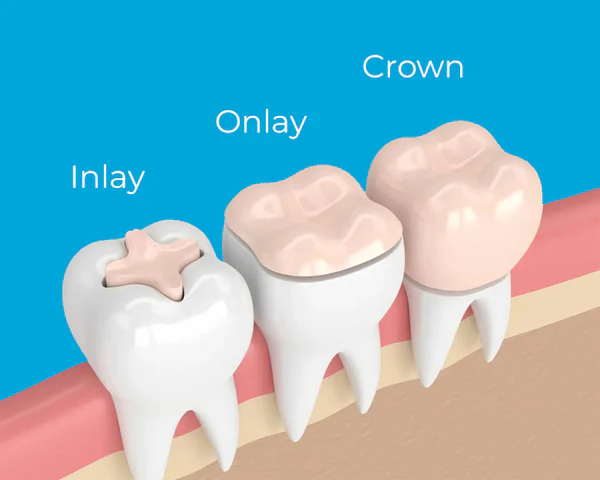
To explain How Inlays and Onlays Work, it helps to picture a tooth like a small hill with peaks and valleys. When decay or damage affects part of that surface, we can remove only the weak area and fill it with a custom-made piece.
- Inlays fit inside the grooves of a tooth, between the raised points
- Onlays extend over one or more of those raised areas
They are often made from porcelain or strong composite materials that blend with your natural tooth color.
How Is This Different From a Crown?
A crown covers the entire visible portion of the tooth. To place one, we must shape the tooth all the way around so the crown can fit over it like a cap.
When learning How Inlays and Onlays Work, patients often realize these restorations leave more of the healthy tooth untouched. Instead of removing large areas, we focus only on the part that truly needs repair.
This approach is often called “conservative dentistry” because it conserves natural structure.
Why Preserving Tooth Structure Matters
Your natural enamel is very strong. Once it is removed, it cannot grow back. The more original teeth we keep, the stronger the tooth can remain over time.
Understanding How Inlays and Onlays Work shows why they are a good choice when damage is moderate but not severe. They reinforce the tooth without the need for full coverage.
Keeping more of your natural tooth can also help with long-term comfort and function.
When Inlays or Onlays Are Recommended
These restorations are often used when a cavity or fracture is too large for a simple filling but not large enough to require a crown.
Examples include:
- Large cavities in back teeth
- Teeth with moderate cracks
- Old, worn fillings that need replacement
In these cases, learning How Inlays and Onlays Work helps patients understand why a middle-ground option can be ideal.
The Step-by-Step Process
The process is straightforward and usually takes two visits unless same-day technology is available.
First Visit
We remove the damaged area and shape the tooth carefully. Then we take a digital scan or impression so the inlay or onlay can be custom-made. A temporary covering may be placed.
Second Visit
The final piece is checked for fit and color, then bonded securely to the tooth.
Because they are bonded in place, understanding How Inlays and Onlays Work also means knowing they help strengthen the remaining tooth structure.
Strength and Durability
Inlays and onlays are designed to handle chewing pressure. Porcelain versions are especially strong and resist staining. When bonded properly, they can last many years with good care.
Patients sometimes think only crowns are strong enough, but learning How Inlays and Onlays Work shows these restorations can also provide lasting support.
Aesthetic Benefits
Since they are made to match the color of your teeth, inlays and onlays blend naturally into your smile. They are a good choice for people who want strength without a noticeable metal filling.
This natural look is another reason conservative dentistry is gaining attention.
When a Crown Is Still Necessary
Not every tooth can be saved with an inlay or onlay. If a tooth is very weak, has deep cracks, or has had a root canal, a crown may still be the better option.
Our goal is always to choose the treatment that gives the tooth the best chance to function well for years.
The Takeaway
So, How Inlays and Onlays Work comes down to targeted repair. We only restore the damaged area of the tooth leaving as much of the natural structure as we can. This is to prevent weakness, discomfort, and poor oral health.
The case of inlays and onlays demonstrates that larger treatment is not necessarily good. In some cases, it is the wisest thing to maintain what is already healthy to have a strong and long lasting smile.